
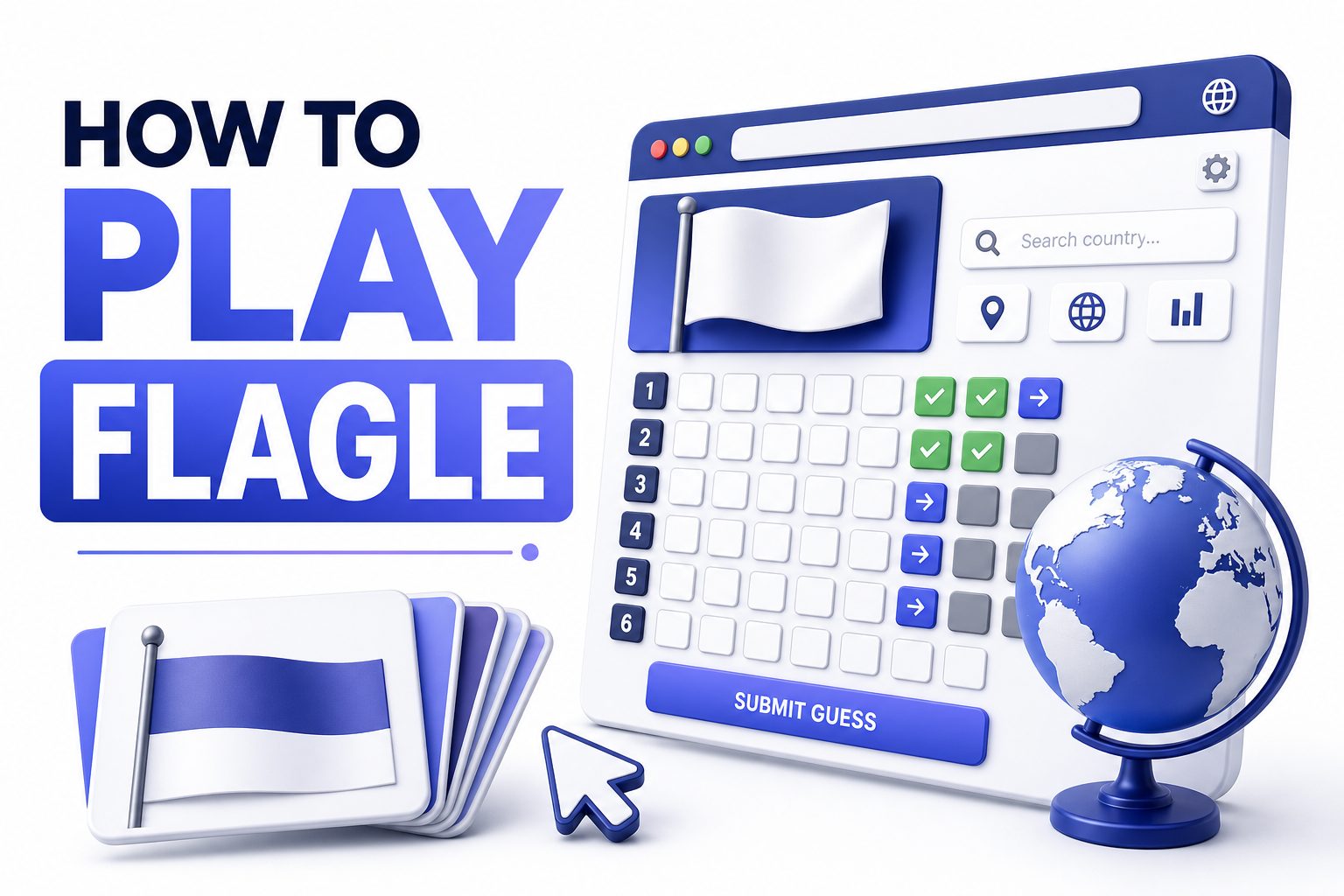
Flagle is a geography guessing game where players identify a hidden country by using flag clues. Each guess reveals more visual information, helping players connect colors, symbols, shapes, and regional knowledge before reaching the correct answer.
The main idea is simple, but the game becomes more engaging when you play with a method. Instead of guessing random countries, you use flag patterns, nearby regions, and national symbols to narrow your options.
Many players enjoy Flagle because it combines memory, logic, and world knowledge. If you like maps, flags, trivia, or daily puzzle games, learning how to play flagle can make each round more rewarding.
Flagle Game Basics
Flagle usually gives players a limited number of attempts to guess the correct country. After each wrong guess, part of the hidden flag appears, giving you another clue for your next attempt.
The game also may show distance or direction hints, depending on the version you play. These hints help you think geographically, especially when your guessed country is close to the answer.
A good Flagle player does not rely only on flag memory. Strong guesses come from combining visual clues with location clues, country names, and common flag design patterns used around the world.
Core Rules of Flagle
Each round starts with a concealed flag. You type the name of a country as your guess, then submit it. If the guess is wrong, the game reveals more of the flag and gives feedback.
Most versions give six attempts, similar to many daily guessing games. The goal is to identify the country before your guesses run out, using every clue as efficiently as possible.
The game rewards careful thinking. A single revealed color, emblem, stripe, or star can point toward a region, political history, or group of countries with similar flag styles.
Key rule points:
You guess one country at a time.
Each wrong guess reveals more flag detail.
You usually have a limited number of attempts.
Clues may include flag sections, distance, or direction.
The answer is normally one country, not a city or region.
Reading Flag Colors
Colors are often the first clue in Flagle. Red, white, blue, green, yellow, and black appear in many national flags, but their arrangement can make them more useful.
For example, red, white, and blue could suggest many countries, including France, Russia, Netherlands, Serbia, Croatia, or the United States. You need layout clues before choosing too quickly.
Green, yellow, and red may point toward African nations, while red and white might suggest countries in Europe, Asia, or the Middle East. Color alone helps, but it rarely gives the full answer.
Spotting Shapes and Layouts
Flag layouts matter as much as colors. Horizontal stripes, vertical stripes, crosses, triangles, circles, stars, and central emblems all provide valuable information during a Flagle round.
Vertical tricolors often make players think of countries like France, Italy, Ireland, Belgium, or Romania. Horizontal tricolors may suggest Germany, Russia, Hungary, Bulgaria, Yemen, or several others.
Triangles on the hoist side can point toward countries such as Palestine, Jordan, Sudan, South Sudan, Czechia, Cuba, or the Philippines. Matching shape with color improves your guessing accuracy.
Using Regional Knowledge
Regional knowledge is one of the strongest tools in Flagle. Many countries in the same area share colors, symbols, or historical design influences, making geography useful after each guess.
African flags often use green, yellow, red, and black, though there are many exceptions. Nordic countries commonly use cross designs, while Arab countries often include red, white, black, and green.
Once you identify a possible region, stop guessing globally. Focus on neighboring countries, shared flag traditions, and regional symbols. This keeps your attempts controlled and prevents wasted guesses.
Common regional clues:
Nordic cross designs often point to Northern Europe.
Pan-African colors may suggest African countries.
Red, white, black, and green often appear in Arab flags.
Blue and white designs may appear in Central America.
Stars, crescents, and suns often carry regional meaning.
Smart First Guess Strategy
Your first guess should give useful information, not just chase a lucky win. Choose a country with recognizable colors and a location that can produce helpful distance feedback.
Some players use large, central, or globally familiar countries as first guesses. Countries like Turkey, Germany, Brazil, India, or South Africa can help test colors, regions, and geographic direction.
A strong first guess also depends on what you already know. If the first revealed section shows green and yellow, choosing a country with those colors can confirm or reject a regional pattern.
Improving Second and Third Guesses
The second guess should respond directly to the first clue. If the revealed flag portion shows a stripe pattern, your next guess should test countries with similar stripe direction and color order.
Avoid jumping to unrelated countries unless the clue clearly supports it. Many players lose because they treat every attempt like a fresh start instead of building from previous evidence.
By the third guess, you should usually have a region or flag family in mind. If not, focus on broad clues such as colors, symbols, stripe layout, and possible continent.
Country Flag Families
Many flags belong to informal design families. These groups share colors, shapes, or historical influences, making them helpful when you are learning how to play flagle more strategically.
For example, many Slavic countries use red, white, and blue. Several Arab countries use similar color sets with horizontal stripes, triangles, stars, or national emblems.
Learning these families helps you avoid random guessing. If a flag resembles one country but is slightly different, think about neighbors, former political unions, and countries with shared cultural symbols.
Helpful flag families:
Slavic flags often use red, white, and blue.
Nordic flags commonly use cross patterns.
Arab flags often share red, white, black, and green.
Central American flags often include blue and white.
Some island nations use blue fields with stars or emblems.
Handling Similar Flags
Similar flags are one of the hardest parts of Flagle. Countries like Chad and Romania, Ireland and Ivory Coast, or Monaco and Indonesia can confuse even experienced players.
The best way to handle similar flags is to slow down and compare details. Look at stripe direction, color shade, symbol placement, proportions, and any emblem that appears later.
If two flags seem almost identical, use geography feedback if available. Distance and direction clues can help separate countries that look similar but sit in very different parts of the world.
Flag Symbols and Emblems
Symbols can quickly change the direction of a round. Stars, crescents, suns, eagles, shields, crosses, and coats of arms often point toward specific countries or regions.
A crescent and star may suggest several countries, including Turkey, Pakistan, Tunisia, Algeria, Azerbaijan, or Malaysia. The colors and layout help decide which one fits best.
Emblems are especially useful when revealed near the center of the flag. A coat of arms or national seal can separate similar stripe designs and lead you to the correct answer.
Useful symbols to notice:
Crescents and stars often appear in Muslim-majority countries.
Suns may appear in flags from Asia, Africa, or island nations.
Coats of arms often identify specific countries.
Crosses can point toward Europe or historical Christian influence.
Stars may show political history, unity, states, or regions.
Building a Guessing Process
A repeatable process makes Flagle easier. Start with visible colors, then identify the layout, then think about regions, then compare symbols, then use geography feedback.
This process prevents emotional guessing. Even when the flag looks unfamiliar, you can still collect evidence and make a reasonable country choice within a limited number of attempts.
You do not need perfect flag knowledge to improve. A structured approach helps you learn from each game, remember patterns, and build stronger instincts over time.
Common Beginner Mistakes
Beginners often guess too quickly after seeing one familiar color. Since many countries share the same colors, early guesses should be careful and based on more than one clue.
Another common mistake is ignoring direction or distance hints. If the game tells you the answer is far from your guess, continuing in the same region may waste attempts.
Some players also forget about small countries. Flagle answers can include nations that are less common in everyday trivia, so it helps to study islands, microstates, and less familiar regions.
Mistakes to avoid:
Guessing only from one color.
Ignoring stripe direction.
Forgetting small or island countries.
Repeating the same region after poor feedback.
Choosing countries without using the newest clue.
Best Practice for Daily Play
Daily play is one of the easiest ways to improve at Flagle. Short, consistent practice helps you remember flags naturally without turning the game into hard study.
After each round, review the correct flag and compare it with your wrong guesses. This helps you notice why your guesses failed and which visual clues mattered most.
You can also keep a small list of confusing flags. Reviewing similar designs for a few minutes each week improves memory faster than trying to memorize every country at once.
Internal Resources for Better Learning
If your site already has geography content, link readers to a related guide using keyword-based anchor text. A useful internal link could be world flag quiz practice if you have a quiz page.
Another natural internal link could point to a country geography guide. This gives readers a next step without forcing the link into the article or interrupting the reading flow.
Internal links should feel helpful. In a blog about Flagle, the best links support flag learning, map knowledge, country facts, geography quizzes, or daily puzzle strategies.
Advanced Flagle Strategy
Advanced players focus on reducing uncertainty. Instead of guessing the first country that looks close, they compare several possible answers before submitting the most useful option.
Sometimes a guess is useful even if it is probably wrong. It can test a color family, region, or flag structure, helping you narrow the answer for later attempts.
The strongest players combine memory with deduction. They know common flags, but they also use logic when the answer is unfamiliar or when several countries share similar designs.
Learning Flags Faster
You can learn flags faster by grouping them instead of memorizing them alphabetically. Groups help your brain connect similar designs and remember differences more clearly.
Start with regions such as Europe, Africa, South America, Central America, and Oceania. Then study confusing pairs and countries with unique symbols or unusual color combinations.
Flashcards, map quizzes, and daily puzzle games work well together. Flagle gives active practice, while quizzes and reference pages fill gaps in memory between games.
Simple study methods:
Study flags by region.
Compare similar pairs side by side.
Review missed answers after each game.
Learn symbols and their common locations.
Practice with short sessions instead of long study blocks.
Why Flagle Is Popular
Flagle is popular because it turns geography into a quick daily challenge. Each round is short, but it still feels satisfying when you solve the country through careful clues.
The game also suits many skill levels. Beginners can enjoy lucky guesses and visual learning, while experienced players can chase lower attempt counts and faster solving times.
Another reason Flagle works well is its balance of memory and reasoning. You may recognize a flag instantly, but unfamiliar rounds still give you a fair path toward the answer.
Playing Without Guessing Randomly
Random guessing can sometimes work, but it usually wastes attempts. A better approach is to treat every guess as a test that should confirm or remove possible answers.
Before submitting, ask whether the country matches the visible colors, layout, region, and any feedback from earlier guesses. If it does not, choose a more logical option.
This habit makes the game calmer and more consistent. Even when you lose, you will understand where your reasoning broke down and what to review before the next round.
Useful Flag Memory Tips
Memory improves when you attach each flag to a clear feature. Instead of trying to remember the whole design, focus on one standout detail that separates it from others.
For example, Nepal has a unique shape, Canada has a maple leaf, Japan has a red circle, and Brazil has a globe inside a yellow diamond. Distinctive details are easier to recall.
For similar flags, remember the difference rather than the full design. Chad and Romania differ mainly in shade, while Ireland and Ivory Coast differ in color order.
Helpful memory habits:
Name one standout feature for each flag.
Learn confusing pairs together.
Connect flags to maps and regions.
Review wrong answers within the same day.
Use short repetition across several weeks.
Playing Flagle on Mobile
Flagle works well on mobile because the game is simple and quick. Still, small screens can make flag details harder to see, especially tiny emblems or narrow stripes.
Zooming in visually, increasing screen brightness, and playing without glare can help. If you often miss small symbols, consider checking the flag carefully before submitting a guess.
Mobile play is best when you avoid rushing. Since typing country names can lead to quick mistakes, confirm the selected country before pressing submit.
Playing Flagle on Desktop
Desktop play gives you more screen space, which helps with detailed flags. Larger visuals make symbols, color borders, and stripe arrangements easier to inspect.
A desktop browser also makes it easier to compare your guesses mentally with map knowledge. You may find it simpler to think through regions when the flag is clearly visible.
If you are practicing seriously, desktop play can be more comfortable. You can keep notes, review missed countries, or study a flag reference after finishing the daily round.
Scoring and Personal Goals
Flagle is often more enjoyable when you set personal goals. Instead of only caring about a perfect first guess, aim to improve your average number of attempts.
A realistic beginner goal is solving most rounds before the final attempt. As your flag knowledge grows, you can aim for three or four guesses more consistently.
Personal goals keep the game enjoyable. Some days will feature unfamiliar countries, and that is part of the learning process rather than a failure.
Good personal goals:
Solve the puzzle within six guesses.
Reduce random guesses over time.
Learn one missed flag after each round.
Improve average attempts each month.
Recognize more regions from color patterns.
Conclusion
Flagle is a simple game with more depth than it first appears. Colors, layouts, symbols, regions, and feedback all work together, giving players many ways to reason toward the hidden country.
The best approach is steady and practical. Use each guess to test a clue, compare similar flags carefully, and review missed answers so your memory improves naturally over time.
If you want to learn how to play flagle well, focus on patterns rather than luck. With daily practice and a clear guessing process, each round becomes easier and more enjoyable.
FAQ
What is Flagle?
Flagle is a country flag guessing game. Players enter country names and use revealed flag sections, colors, symbols, and sometimes geography clues to identify the hidden national flag within a limited number of attempts.
How many guesses are in Flagle?
Most Flagle versions give players six guesses. After each incorrect guess, more of the hidden flag appears, helping you use visual clues and country knowledge to choose a better next answer.
Is Flagle good for learning geography?
Yes, Flagle can help improve geography knowledge. It teaches country flags, regional patterns, national symbols, and map awareness through short daily practice, making it useful for casual learners and trivia fans.
What is the best first guess in Flagle?
A good first guess should provide useful information. Choose a country with familiar colors and a strategic location, then use the feedback to narrow the possible region, flag style, and country group.
Why are some flags hard to identify?
Some flags are hard because many countries share similar colors, stripes, symbols, or historical designs. Careful comparison of layout, color order, emblems, and geography clues helps separate similar-looking national flags.
0 Comments